Psychology
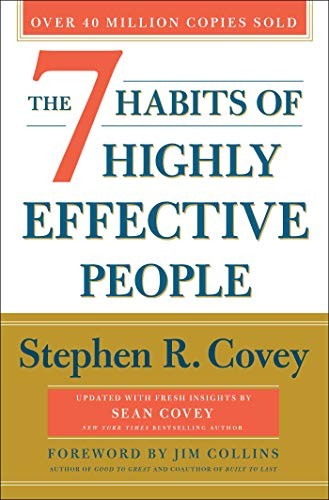
The 7 Habits of Highly Effective People
by Stephen Covey · 1989 · 521 pages
★4.16· 432K ratings
The 7 Habits of Highly Effective People
Covey's insight: most people focus on becoming better at getting things done. The real work is becoming the kind of person for whom the right things get done naturally.
Takeaway 1: Character Ethics vs. Personality Ethics
Covey opens The 7 Habits with an observation about self-help literature: for most of American history, the literature of success focused on character — integrity, humility, fidelity, temperance, industry. Starting around the 1920s, the emphasis shifted to personality — social skills, positive mental attitude, appearance, impression management.
The shift was costly. Personality ethics treats effectiveness as a set of techniques you can apply to problems. Character ethics recognizes that lasting effectiveness flows from who you actually are — your deep values, your actual trustworthiness, your genuine care for others.
You can't technique your way to deep trust. You can't manage people's long-term respect for you. These are built slowly through character — by being someone whose word means something, who takes responsibility, who acts from principle rather than expediency.
This is the frame for everything that follows.
Takeaway 2: The Maturity Continuum — Dependence to Interdependence
Covey organizes the seven habits along a continuum of maturity:
Habits 1–3 (Private Victory): Independence
- Habit 1: Be Proactive — you are responsible for your own life
- Habit 2: Begin With the End in Mind — know what matters before acting
- Habit 3: Put First Things First — schedule priorities, don't prioritize your schedule
These three move from dependence (being controlled by circumstances and others) to independence (self-mastery, self-direction).
Habits 4–6 (Public Victory): Interdependence
- Habit 4: Think Win/Win — seek solutions that benefit both parties
- Habit 5: Seek First to Understand, Then to Be Understood — listen before speaking
- Habit 6: Synergize — creative cooperation produces outcomes better than either party could achieve alone
The most common mistake: skipping to habits 4–6 without the foundation of 1–3. You cannot build strong relationships on an unstable self.
Takeaway 3: Sharpen the Saw
The seventh habit — one most people skim past — is what Covey considers the most important: continuous renewal in four dimensions of your life.
Physical: Exercise, nutrition, rest. The body is the instrument for all other activity.
Mental: Reading, reflection, learning. The habit of continuously expanding your mental model.
Social/Emotional: Building relationships, serving others, developing empathy. The practice of interdependence.
Spiritual: Clarifying values, meditation, connection to something larger than yourself. What gives the other activities meaning.
The metaphor: if you saw wood for weeks without sharpening the blade, you'll eventually be working much harder for much less result. Renewal isn't a reward for work — it's what makes the work sustainable.
Most people feel too busy to renew. But not renewing is what makes you feel too busy.
Analysis
The 7 Habits of Highly Effective People has sold over 40 million copies and is routinely listed among the most influential business and self-help books ever written. Its influence on organizational culture has been enormous — and for legitimate reasons.
What distinguishes Covey from most productivity writers is his insistence that effectiveness is ultimately a question of character, not technique. You can't sustainably manage your time well without knowing your values. You can't lead effectively without being trustworthy.
The book is long and dense and occasionally redundant. But the framework it contains is genuinely comprehensive.
About the Author
Stephen Covey (1932–2012) was an American educator, author, businessman, and keynote speaker. He was professor at the Jon M. Huntsman School of Business at Utah State University. In 1989, Time magazine named him one of the 25 most influential Americans. He died in 2012.
You Might Also Like
See all →
Man's Search for Meaning
Viktor Frankl
Maybe You Should Talk to Someone
Lori Gottlieb
Never Split the Difference
Chris Voss
The Body Keeps the Score
Bessel van der Kolk

Nonviolent Communication
Marshall Rosenberg

Atomic Habits
James Clear

The 5 Love Languages
Gary Chapman

The Psychology of Money
Morgan Housel

The Seven Principles for Making Marriage Work
John Gottman
The Gifts of Imperfection
Brené Brown

How to Win Friends and Influence People
Dale Carnegie
Influence
Robert Cialdini