Mental Health
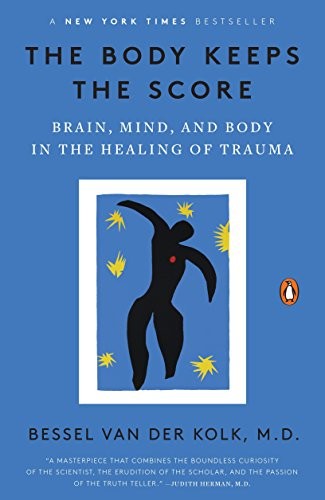
The Body Keeps the Score
by Bessel van der Kolk · 2014 · 464 pages
★4.34· 412K ratings
The Body Keeps the Score
Trauma doesn't live in memories. It lives in the body. Understanding this changes everything about how we heal.
Takeaway 1: Trauma Is a Physiological Condition, Not Just a Psychological One
For decades, trauma treatment focused on helping people talk through their experiences — process them, reframe them, understand them. But van der Kolk's research showed this approach misses something fundamental.
Trauma reorganizes the brain and body. In traumatized people:
- The amygdala (threat detection) becomes hypersensitive
- The prefrontal cortex (rational thought, language) goes offline during triggers
- The body stores the experience as a physical memory in the nervous system
This is why people can understand intellectually that they're safe but still have panic attacks. The understanding is in the cortex. The panic is in the brainstem. These systems don't communicate well under threat.
Talking about trauma can help. But you can't talk your way out of a physiological state.
Takeaway 2: Trauma Changes How We See Ourselves and Others
Trauma does more than create flashbacks and nightmares. It changes the way people relate to themselves and to other people.
Van der Kolk describes three characteristic shifts:
- Hypervigilance: Constant scanning for threat, even in safe environments. The body is perpetually on alert.
- Emotional dysregulation: Swinging between feeling too much and feeling nothing. The thermostat is broken.
- Disconnection from self: Many trauma survivors feel cut off from their own bodies — numb, unreal, like they're watching themselves from outside.
These are not character flaws. They're adaptations. In genuinely dangerous environments, they made sense. The problem is that the nervous system doesn't know when danger has passed.
Takeaway 3: Healing Must Involve the Body
If trauma lives in the body, treatment must reach the body. Van der Kolk identifies several approaches with strong evidence:
EMDR (Eye Movement Desensitization and Reprocessing): Bilateral eye movements while recalling traumatic memories help the brain process them differently — moving them from raw, present-tense threat to past event.
Yoga: Helps trauma survivors reconnect with their bodies in a safe, controllable way. Regulated breathing activates the parasympathetic nervous system, the body's "rest and digest" mode.
Somatic experiencing: Focuses on the physical sensations of trauma — completing interrupted threat responses that got stuck in the nervous system.
Theater and movement: Van der Kolk devotes surprising space to this. Embodied, communal, rhythmic activities — drumming, dance, theater — show strong results because they access non-verbal parts of the brain.
The common thread: healing requires helping the nervous system learn that danger has passed — something words alone often can't accomplish.
Analysis
The Body Keeps the Score changed the public conversation about trauma when it was published in 2014. Its central argument — that trauma is a physiological condition requiring physiological interventions — was not new in the research literature but was new to most clinicians and nearly all laypeople.
The book is long and sometimes dense, but van der Kolk's decades of clinical work with veterans, abuse survivors, and refugees give it a weight that purely theoretical books lack. He describes patients, failures, and evolutions in his own thinking with unusual honesty.
The most important shift it produces in readers: replacing judgment with understanding. When you understand why trauma survivors behave the way they do, behavior that looked like weakness or choice looks like adaptation.
About the Author
Bessel van der Kolk is a Dutch psychiatrist and researcher who has studied trauma for over four decades. He founded and directs the Trauma Research Foundation in Boston and is a professor of psychiatry at Boston University School of Medicine. He was one of the first researchers to document PTSD using brain imaging.
You Might Also Like
See all →
Maybe You Should Talk to Someone
Lori Gottlieb
The Gifts of Imperfection
Brené Brown
Reasons to Stay Alive
Matt Haig

Secure Love
Julie Menanno
Obsessed
Allison Britz

Relationship OCD
Sheva Rajaee

Far From The Tree
Andrew Solomon
The Codependency Recovery Plan
Krystal Mazzola

When Things Fall Apart
Pema Chodron

This Naked Mind
Annie Grace

8 Keys to Safe Trauma Recovery
Babette Rothschild