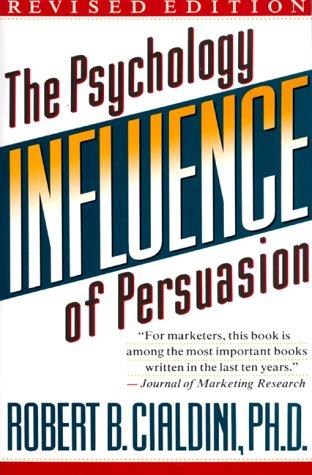
Psychology
Influence
by Robert Cialdini · 1984 · 320 pages
★4.21· 312K ratings
Influence
Six universal principles make people say yes. Once you see them, you can't unsee them — in sales pitches, political speeches, and conversations you thought were just conversations.
Takeaway 1: Persuasion Uses Mental Shortcuts
Most of the time, we don't decide by thinking. We use shortcuts — mental rules of thumb that evolved because they usually worked.
Cialdini spent years studying what gets people to say yes. He found six principles that work across cultures and contexts. They're not tricks — they're features of human psychology that normally serve us well. The danger is when they're deliberately triggered without the underlying reality being present.
Takeaway 2: The Six Principles of Influence
Reciprocity — When someone gives us something, we feel obligated to give back. Free samples work not because they let you try the product, but because they activate a debt response. The Hare Krishna who hands you a flower before asking for a donation has used this principle.
Commitment and Consistency — Once we've taken a position, we work to stay consistent with it. Small commitments lead to large ones. Foot-in-the-door technique: get a yes on something small first.
Social Proof — When uncertain, we look at what others are doing. Laugh tracks in sitcoms. "4.8 stars from 12,000 reviews." Testimonials. We use the behavior of others as information about correct action.
Authority — We defer to experts. This is mostly rational — doctors know more about medicine than we do. But we also defer to symbols of authority (white coats, titles, confidence) even without actual expertise.
Liking — We say yes to people we like. We like people who are similar to us, who compliment us, who are familiar, or attractive. Your salesman mentioning he grew up in your hometown isn't coincidence.
Scarcity — We want what we might lose. "Only 3 left in stock." Real scarcity is real information. Manufactured scarcity is manipulation.
Takeaway 3: Awareness Is the Defense
Understanding these principles doesn't make you immune. They're automatic — they fire before conscious thought can intervene.
But awareness gives you a pause button. When you feel the pull to say yes — from a sense of debt, pressure to be consistent, what everyone else is doing, an authoritative voice, a likable face, or urgency from scarcity — you can ask: Is the underlying reality actually present here, or just the trigger?
Real obligations deserve reciprocation. Real social proof from actually-similar people is useful. Real authority from actual experts deserves deference. Real scarcity is real information.
The skill is distinguishing the signal from the manufactured trigger.
Analysis
Influence is one of the most cited books in marketing, sales, and psychology. Published in 1984 and updated in 2021 with a seventh principle (Unity), it remains the definitive text on the mechanics of persuasion.
What makes Cialdini's work powerful is that it isn't cynical — these principles describe real adaptive mechanisms. Reciprocity built human communities. Social proof is genuinely informative in uncertain situations. Authority shortcuts are usually rational.
The book's dual purpose: use these principles ethically when you need to influence, and recognize them when they're being used on you.
About the Author
Robert Cialdini is Regents' Professor Emeritus of Psychology and Marketing at Arizona State University. He spent three years going undercover in sales, fundraising, and advertising to study influence in real-world settings. Influence has sold over 5 million copies and been translated into 44 languages.
You Might Also Like
See all →
Man's Search for Meaning
Viktor Frankl

Maybe You Should Talk to Someone
Lori Gottlieb
Never Split the Difference
Chris Voss

The Body Keeps the Score
Bessel van der Kolk

Nonviolent Communication
Marshall Rosenberg

Atomic Habits
James Clear

The 5 Love Languages
Gary Chapman

The Psychology of Money
Morgan Housel

The Seven Principles for Making Marriage Work
John Gottman
The Gifts of Imperfection
Brené Brown

How to Win Friends and Influence People
Dale Carnegie