Psychology
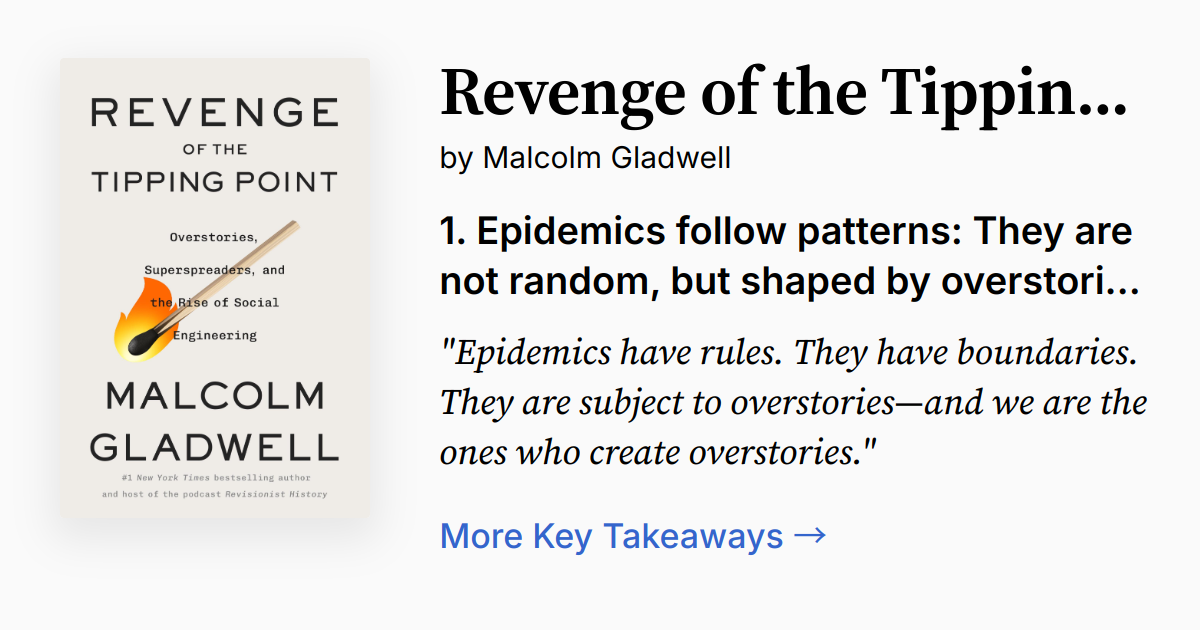
Revenge of the Tipping Point
by Malcolm Gladwell · 2024 · 352 pages
★4.55· 605 ratings
Revenge of the Tipping Point
Epidemics follow patterns: They are not random, but shaped by overstories and group dynamics
"Epidemics have rules. They have boundaries. They are subject to overstories—and we are the ones who create overstories." Epidemics are not chaotic. They follow discernible patterns influenced by three key factors: Understanding these patterns allows us to predict, manage, and potentially prevent epidemics. This applies not just to disease outbreaks, but to social phenomena like crime waves, fashion trends, and cultural shifts. "Miami became Miami because of an extraordinary confluence of events at the end of the 1970s: the influx of Cuban refugees, the rise of the cocaine trade, and a race ri
Lesson 1: Epidemics follow patterns: They are not random, but shaped by overstories and group dynamics
This principle from Revenge of the Tipping Point is backed by Malcolm Gladwell's extensive research and real-world examples. Understanding it deeply can shift how you approach decisions, relationships, and long-term planning in meaningful ways.
Lesson 2: Small-area variation: Local context profoundly influences epidemic spread
This principle from Revenge of the Tipping Point is backed by Malcolm Gladwell's extensive research and real-world examples. Understanding it deeply can shift how you approach decisions, relationships, and long-term planning in meaningful ways.
Lesson 3: The power of overstories: Cultural narratives shape epidemic trajectories
Malcolm Gladwell reveals how the stories we tell ourselves shape outcomes as powerfully as external reality. In Revenge of the Tipping Point, this psychological insight becomes a practical tool: change the narrative, change the result.
How to Apply Revenge of the Tipping Point's Lessons
The real value of Revenge of the Tipping Point lies in its applicability. After reading, the most important step is identifying which of Malcolm Gladwell's principles speak most directly to your current situation.
Consider keeping a journal while reading — noting where the ideas challenge your current approach and where they confirm what you already suspected. The friction of your own resistance often points to the most important insights.
Key Quote
"Epidemics follow patterns: They are not random, but shaped by overstories and group dynamics" — Malcolm Gladwell, Revenge of the Tipping Point
About the Author
Malcolm Gladwell is the author of Revenge of the Tipping Point. The book reflects years of research, observation, and synthesis of evidence from multiple disciplines.
You Might Also Like
See all →
Man's Search for Meaning
Viktor Frankl
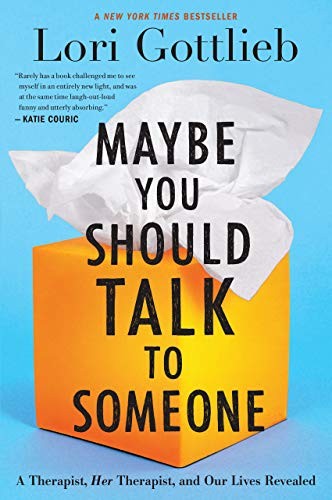
Maybe You Should Talk to Someone
Lori Gottlieb
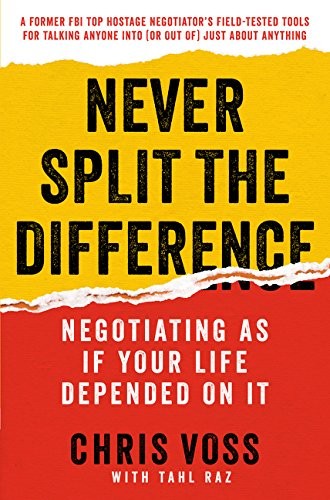
Never Split the Difference
Chris Voss

The Body Keeps the Score
Bessel van der Kolk

Nonviolent Communication
Marshall Rosenberg

Atomic Habits
James Clear

The 5 Love Languages
Gary Chapman

The Psychology of Money
Morgan Housel

The Seven Principles for Making Marriage Work
John Gottman
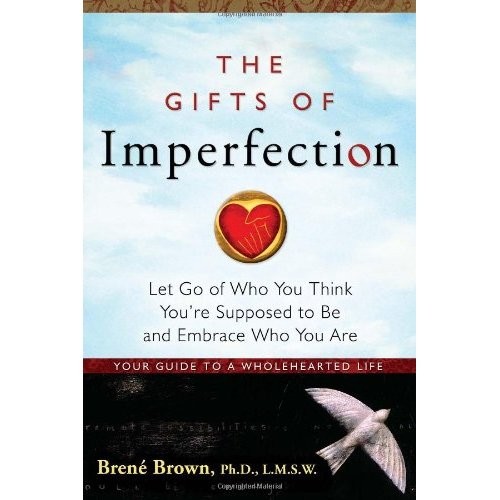
The Gifts of Imperfection
Brené Brown

How to Win Friends and Influence People
Dale Carnegie
Influence
Robert Cialdini