Psychology
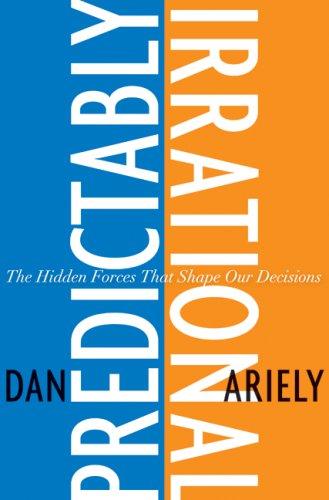
Predictably Irrational
by Dan Ariely · 2008 · 349 pages
★4.12· 246K ratings
Predictably Irrational
We think we're rational. We're not. But our irrationality isn't random — it follows predictable patterns that Ariely spent years mapping through clever experiments.
Takeaway 1: Our Irrationality Is Systematic
Classical economics assumes rational actors: people who make consistent decisions that maximize their own welfare based on accurate assessment of costs and benefits. Dan Ariely spent his career demonstrating that this assumption is wrong — and that the errors are not random.
We are predictably irrational. Our biases are consistent and follow regular patterns that can be studied, mapped, and anticipated. This is bad news for the rational-actor model. It's good news for anyone who wants to understand their own behavior.
Three examples from Ariely's experiments:
Relativity: We don't judge prices or values in absolute terms — we compare. Put a mediocre option next to a clearly inferior "decoy" option and the mediocre option suddenly looks good. This is why restaurants put very expensive items on menus: not to sell them, but to make everything else look reasonable by comparison.
Zero cost: The word "free" triggers an irrational response. When something is free, we dramatically overestimate its value. A free item that we'd otherwise ignore becomes irresistible.
Expectations: What we believe we'll experience shapes what we actually experience. People rate the same wine as better when told it's expensive. Pain medication works better when patients believe it's strong. The placebo effect is not weakness — it's the power of expectation over experience.
Takeaway 2: Social Norms vs. Market Norms
One of Ariely's most revealing experiments: asking people to help move furniture. When asked as a favor, most were willing. When offered a small payment, most declined. Introducing money changed the entire frame from social obligation to market transaction — and made the outcome worse.
Social norms (reciprocity, goodwill, community) and market norms (explicit exchange, payment, transactional thinking) operate by different rules. They don't mix well. Once a market frame is introduced into a social context, the social norms disappear and are very hard to restore.
The implication: in relationships — romantic, friendship, family — be careful about creating market frames. Charging friends for favors, keeping strict reciprocal tallies, and making everything transactional erodes the social bonds that make those relationships valuable.
Takeaway 3: The High Price of Ownership
We overvalue things we own relative to things we don't. Ariely calls this the endowment effect. In experiments, people consistently demand more to give up an object they own than they would have paid to acquire the same object.
The cognitive mechanism: once we own something, we start imagining not having it — the loss becomes more salient than the gain. We begin constructing stories about its value that go beyond its actual worth.
This affects more than objects. We overvalue our own ideas, our habitual approaches, our existing beliefs. We're reluctant to give up what we have — relationships, jobs, positions — even when exchange would benefit us. The ownership bias affects decisions across domains.
Analysis
Predictably Irrational is a delight to read. Ariely's experiments are clever and his writing is clear. Where Kahneman and Tversky documented cognitive biases from a psychology research perspective, Ariely brings them to life in vivid, relatable scenarios from everyday economic life.
The book complements Thinking, Fast and Slow well — both are about systematic errors in human reasoning, approached from slightly different angles. Read together, they form an unusually complete picture of how human judgment actually works.
About the Author
Dan Ariely is the James B. Duke Professor of Psychology and Behavioral Economics at Duke University. He founded the Center for Advanced Hindsight and has written several books on irrational behavior. He has given three TED Talks on behavioral economics with a combined 20+ million views.
You Might Also Like
See all →
Man's Search for Meaning
Viktor Frankl

Maybe You Should Talk to Someone
Lori Gottlieb
Never Split the Difference
Chris Voss

The Body Keeps the Score
Bessel van der Kolk

Nonviolent Communication
Marshall Rosenberg

Atomic Habits
James Clear

The 5 Love Languages
Gary Chapman

The Psychology of Money
Morgan Housel

The Seven Principles for Making Marriage Work
John Gottman

The Gifts of Imperfection
Brené Brown

How to Win Friends and Influence People
Dale Carnegie
Influence
Robert Cialdini