Psychology
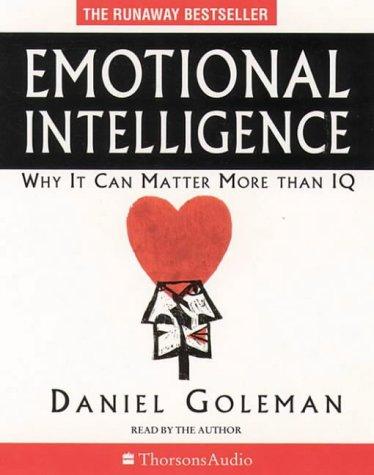
Emotional Intelligence
by Daniel Goleman · 1995 · 351 pages
★4.06· 348K ratings
Emotional Intelligence
IQ predicts about 20% of career success. The other 80% comes from emotional intelligence — the ability to understand and manage emotions in yourself and others.
Takeaway 1: Emotional Intelligence Is More Predictive Than IQ
When Goleman published this book in 1995, the idea that emotional competencies could matter more than cognitive intelligence was genuinely controversial. The evidence he assembled was compelling enough to shift the conversation permanently.
The research showed that IQ predicts about 20% of career success. Academic credentials predict even less. What consistently predicted success — in management, sales, negotiation, leadership, and most human endeavors that involve other people — was a cluster of skills that Goleman called emotional intelligence.
Crucially: emotional intelligence is not a fixed trait. It can be developed. This is what separates it from IQ, which is largely stable after childhood.
Takeaway 2: The Five Domains of Emotional Intelligence
Goleman identifies five components:
Self-awareness — Knowing your own emotional state in real time. Recognizing when you're anxious, defensive, triggered, or reactive — and what that does to your judgment.
Self-regulation — Managing your emotional responses, especially negative ones. Not suppressing emotions but not being ruled by them either. The ability to pause between stimulus and response.
Motivation — Internal drive that persists beyond external rewards. The capacity to keep going when results are distant or uncertain.
Empathy — Reading other people's emotional states accurately. The foundation of all social competence. Goleman identifies empathy as the single most important emotional skill for leadership.
Social skills — The ability to manage relationships, influence people, build networks, and navigate conflict. Everything downstream from empathy.
Takeaway 3: The Amygdala Hijack
One of Goleman's most practically useful concepts: the amygdala hijack — moments when an emotional stimulus triggers a threat response so fast that rational thought is bypassed entirely.
In these moments, the prefrontal cortex (reasoning, planning, judgment) effectively goes offline. You say things you regret. You make decisions you'd never make when calm. You cannot think straight — literally.
The key fact: the amygdala hijack takes about 18-20 seconds to resolve once triggered. You can't think your way out of it faster. The only practical move is to create a pause — leave the room, take a breath, buy time — until the physiological response settles.
Knowing you've been hijacked is itself a form of self-awareness. Most people in the middle of an emotional reaction are convinced they're being completely rational.
Analysis
Emotional Intelligence created a cultural moment when it was published. The phrase entered common usage almost immediately. The book has been criticized (fairly) for overstating the research base and making broader claims than the data supported.
But the core insight holds: social and emotional competencies predict important life outcomes in ways that IQ does not, and these competencies are learnable. This is one of the more hopeful findings in all of psychology.
About the Author
Daniel Goleman is a psychologist and science journalist who reported on brain and behavioral sciences for The New York Times for twelve years. He is a co-founder of the Collaborative for Academic, Social, and Emotional Learning (CASEL) and has written several books on emotional intelligence, leadership, and focus.
You Might Also Like
See all →
Man's Search for Meaning
Viktor Frankl
Maybe You Should Talk to Someone
Lori Gottlieb
Never Split the Difference
Chris Voss
The Body Keeps the Score
Bessel van der Kolk

Nonviolent Communication
Marshall Rosenberg

Atomic Habits
James Clear

The 5 Love Languages
Gary Chapman

The Psychology of Money
Morgan Housel

The Seven Principles for Making Marriage Work
John Gottman
The Gifts of Imperfection
Brené Brown

How to Win Friends and Influence People
Dale Carnegie
Influence
Robert Cialdini