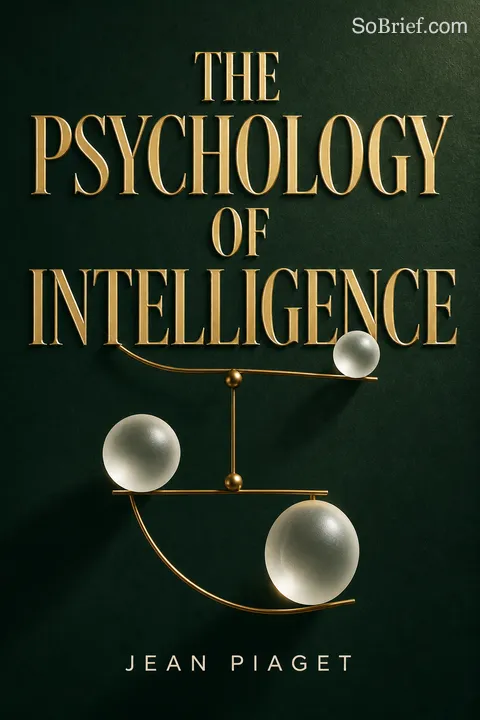
Philosophy
The Psychology of Intelligence
by Jean Piaget · 1984
★4.50
The Psychology of Intelligence
10 Takeaways: 1) Intelligence is the highest form of biological adaptation, balancing assimilation and accommodation.
Key Insight 1: Intelligence is the highest form of biological adaptation, balancing assimilation and accommodation.
This insight from The Psychology of Intelligence by Jean Piaget represents one of the foundational ideas in this philosophical work.
Key Insight 2: Intelligence is fundamentally operational, built from internalized, reversible actions forming structured systems called groupings.
This insight from The Psychology of Intelligence by Jean Piaget represents one of the foundational ideas in this philosophical work.
Key Insight 3: Perception differs from intelligence by its irreversible, statistical nature, while intelligence achieves objective relativity through mobile, reversible operations.
This insight from The Psychology of Intelligence by Jean Piaget represents one of the foundational ideas in this philosophical work.
Key Insight 4: Habit and sensori-motor intelligence share origins in sensori-motor assimilation, with intelligence extending beyond immediate, rigid responses.
This insight from The Psychology of Intelligence by Jean Piaget represents one of the foundational ideas in this philosophical work.
Key Insight 5: Sensori-motor intelligence develops through stages of increasingly complex action schemata, culminating in practical object permanence and spatial groups.
This insight from The Psychology of Intelligence by Jean Piaget represents one of the foundational ideas in this philosophical work.
Key Insight 6: Thought develops through pre-operational stages (symbolic, preconceptual, intuitive) marked by egocentricity, phenomenalism, and irreversible mental experiments.
This insight from The Psychology of Intelligence by Jean Piaget represents one of the foundational ideas in this philosophical work.
Key Insight 7: Concrete operational thought emerges with the formation of reversible groupings, enabling conservation and logical reasoning tied to manipulable objects.
This insight from The Psychology of Intelligence by Jean Piaget represents one of the foundational ideas in this philosophical work.
Key Insight 8: Formal operational thought, appearing in adolescence, involves operating on operations, enabling hypothetico-deductive reasoning independent of concrete reality.
This insight from The Psychology of Intelligence by Jean Piaget represents one of the foundational ideas in this philosophical work.
Key Insight 9: Intellectual development is a hierarchy of successive constructions, where each level coordinates and differentiates structures from the preceding one.
This insight from The Psychology of Intelligence by Jean Piaget represents one of the foundational ideas in this philosophical work.
Key Insight 10: Social interaction, particularly cooperation, is crucial for the development of logic by fostering the coordination and decentralization of viewpoints.
This insight from The Psychology of Intelligence by Jean Piaget represents one of the foundational ideas in this philosophical work.
You Might Also Like
See all →
Man's Search for Meaning
Viktor Frankl

Doorway to Artistry
Esther Lightcap Meek

IGNORANCE (L')
Milan Kundera

Awakening From the Meaning Crisis
John Vervaeke
Buddhism
Alan W. Watts
Power, Freedom, and Grace
Deepak Chopra
365 Science of Mind
Ernest Shurtleff Holmes
The Psychology of Human Misjudgement
Charles T. Munger

Everything Is Never Enough
Bobby Jamieson

Hyperreality
Mike Hockney

Love Thy Body
Nancy R. Pearcey

The Matter With Things
Iain McGilchrist