Philosophy
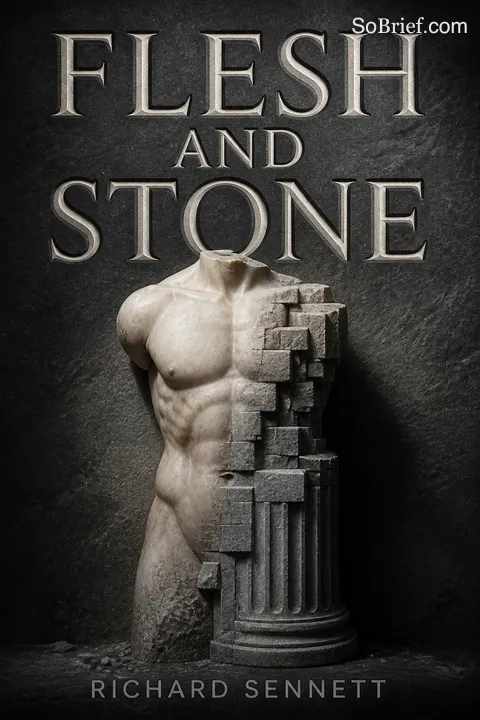
Flesh and Stone
by Richard Sennett · 1984
★4.61
Flesh and Stone
12 Takeaways: 1) Urban history is a story of the body's experience in stone.
Key Insight 1: Urban history is a story of the body's experience in stone.
This insight from Flesh and Stone by Richard Sennett represents one of the foundational ideas in this philosophical work.
Key Insight 2: Ancient Athens linked the naked body, voice, and civic space, but used physiology to justify social exclusion.
This insight from Flesh and Stone by Richard Sennett represents one of the foundational ideas in this philosophical work.
Key Insight 3: Ritual offered marginalized groups in Athens hidden spaces for bodily dignity and community.
This insight from Flesh and Stone by Richard Sennett represents one of the foundational ideas in this philosophical work.
Key Insight 4: Roman power built visual order and geometric forms based on the body, demanding belief and obedience.
This insight from Flesh and Stone by Richard Sennett represents one of the foundational ideas in this philosophical work.
Key Insight 5: Early Christianity sought spiritual transformation by transcending the body and worldly place.
This insight from Flesh and Stone by Richard Sennett represents one of the foundational ideas in this philosophical work.
Key Insight 6: Medieval cities fostered Christian community and compassion, creating sanctuaries for suffering bodies.
This insight from Flesh and Stone by Richard Sennett represents one of the foundational ideas in this philosophical work.
Key Insight 7: Economic individualism in medieval cities introduced flexible space and time, challenging fixed social and religious order.
This insight from Flesh and Stone by Richard Sennett represents one of the foundational ideas in this philosophical work.
Key Insight 8: Renaissance Venice used spatial segregation to manage fears of difference and bodily impurity, linking community to repression.
This insight from Flesh and Stone by Richard Sennett represents one of the foundational ideas in this philosophical work.
Key Insight 9: The scientific revolution's focus on bodily circulation inspired urban planning based on flow and health, promoting individual mobility.
This insight from Flesh and Stone by Richard Sennett represents one of the foundational ideas in this philosophical work.
Key Insight 10: Revolutionary Paris sought freedom in empty volumes, but this space pacified the body and dispersed the crowd.
This insight from Flesh and Stone by Richard Sennett represents one of the foundational ideas in this philosophical work.
Key Insight 11: Modern urban individualism, driven by speed and comfort, leads to sensory detachment and social indifference.
This insight from Flesh and Stone by Richard Sennett represents one of the foundational ideas in this philosophical work.
Key Insight 12: True civic connection requires acknowledging bodily insufficiency and engaging with difference, resisting passive comfort.
This insight from Flesh and Stone by Richard Sennett represents one of the foundational ideas in this philosophical work.
You Might Also Like
See all →
Man's Search for Meaning
Viktor Frankl

Doorway to Artistry
Esther Lightcap Meek

IGNORANCE (L')
Milan Kundera
Awakening From the Meaning Crisis
John Vervaeke
Buddhism
Alan W. Watts
Power, Freedom, and Grace
Deepak Chopra
365 Science of Mind
Ernest Shurtleff Holmes
The Psychology of Human Misjudgement
Charles T. Munger

Everything Is Never Enough
Bobby Jamieson

Hyperreality
Mike Hockney
Love Thy Body
Nancy R. Pearcey
The Matter With Things
Iain McGilchrist