Business
Systems Thinking For Social Change
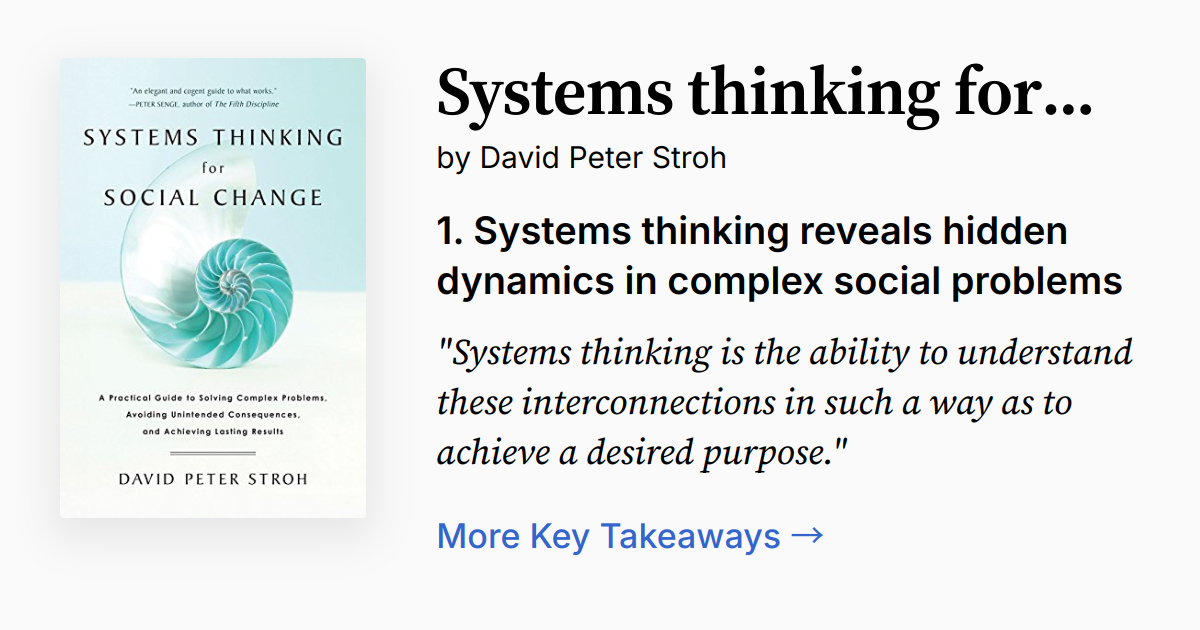
by David Peter Stroh · 2024 · 264 pages
★4.33· 402 ratings
Systems Thinking For Social Change
Systems thinking reveals hidden dynamics in complex social problems
Systems thinking is the ability to understand these interconnections in such a way as to achieve a desired purpose. Interconnected web of factors. Systems thinking provides a powerful lens for understanding why complex social problems persist despite our best efforts to solve them. It reveals the often hidden web of interconnected factors, feedback loops, and time delays that shape system behavior. By mapping these dynamics visually, we can see how different parts of a system influence each other in non-obvious ways. Holistic perspective. Rather than looking at isolated events or linear cause-
Lesson 1: Systems thinking reveals hidden dynamics in complex social problems
This principle from Systems Thinking For Social Change is backed by David Peter Stroh's extensive research and real-world examples. Understanding it deeply can shift how you approach decisions, relationships, and long-term planning in meaningful ways.
Lesson 2: Good intentions often fall short due to unintended consequences
This principle from Systems Thinking For Social Change is backed by David Peter Stroh's extensive research and real-world examples. Understanding it deeply can shift how you approach decisions, relationships, and long-term planning in meaningful ways.
Lesson 3: Systemic change requires shifting from blame to shared responsibility
This principle from Systems Thinking For Social Change is backed by David Peter Stroh's extensive research and real-world examples. Understanding it deeply can shift how you approach decisions, relationships, and long-term planning in meaningful ways.
How to Apply Systems Thinking For Social Change's Lessons
The real value of Systems Thinking For Social Change lies in its applicability. After reading, the most important step is identifying which of David Peter Stroh's principles speak most directly to your current situation.
Consider keeping a journal while reading — noting where the ideas challenge your current approach and where they confirm what you already suspected. The friction of your own resistance often points to the most important insights.
Key Quote
"Systems thinking reveals hidden dynamics in complex social problems" — David Peter Stroh, Systems Thinking For Social Change
About the Author
David Peter Stroh is the author of Systems Thinking For Social Change. The book reflects years of research, observation, and synthesis of evidence from multiple disciplines.
You Might Also Like
See all →
Never Split the Difference
Chris Voss
Zero to One
Peter Thiel

Broken Money
Lyn Alden

$100M Leads
Alex Hormozi

Less Is More
Jason Hickel

Main Street Millionaire
Codie Sanchez

Broken Money
Lyn Alden

The 38 Letters from J.D. Rockefeller to His Son
范毅然

High Output Management
Andrew S. Grove

Never Enough
Andrew Wilkinson

Breakthrough Advertising
Eugene M. Schwartz

The Simple Path to Wealth
J.L. Collins